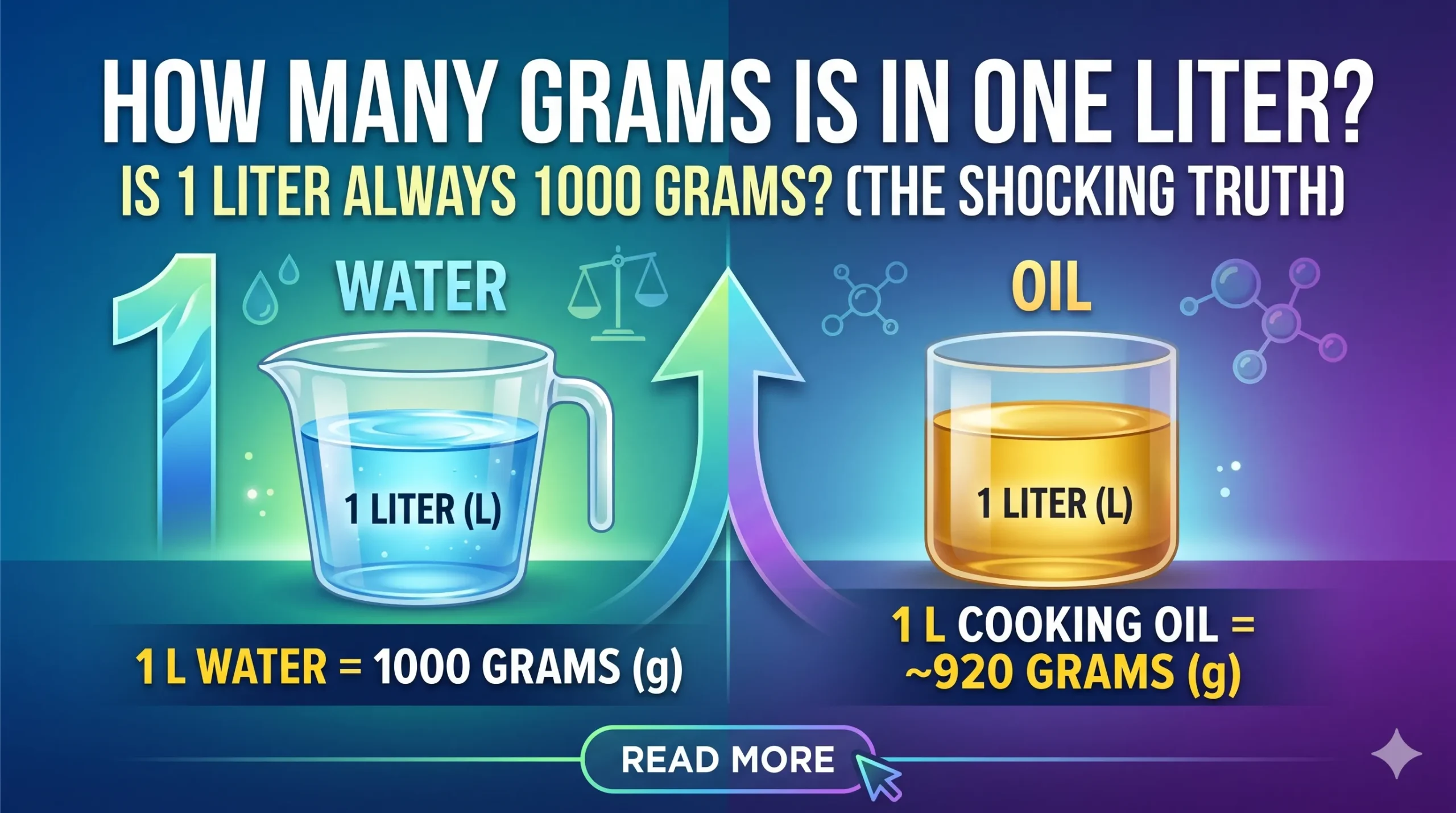
One liter equals 1,000 grams only for water. For every other liquid, the gram value changes because grams measure mass while liters measure volume, and the link between them is density.
FREE Printable Grams to Cups Chart (PDF) Flour, sugar, butter and more. Complete a quick offer to unlock. →Quick Answer
- 1 liter of water = 1,000 grams (under normal conditions)
- For any other substance, grams = liters × density
- If you don’t know the substance’s density, you cannot give an exact gram value.
Why There Is No Single “Grams in 1 Liter” Number
A liter measures volume (how much space something takes up).
A gram measures mass (how heavy something is).
Because these are different physical quantities, the same volume can have different masses depending on the density of the substance. That’s why:
- 1 liter of oil weighs less than 1 liter of water
- 1 liter of honey weighs more than 1 liter of water
- 1 liter of water is used as the standard example: 1,000 grams
So the correct answer always depends on what liquid you’re talking about.
Clean Conversion Table (Common Liquids)
| Substance | Approx. grams in 1 liter | Why it differs |
|---|---|---|
| Water | 1,000 g | Standard reference: 1 L water ≈ 1 kg |
| Vegetable oil | ~900–930 g | Less dense than water |
| Olive oil | ~915 g | Slightly lighter than water |
| Milk | ~1,030 g | Slightly denser than water |
| Honey | ~1,400 g or more | Much denser than water |
| Alcohol (ethanol) | ~789 g | Significantly less dense than water |
| Syrup | ~1,300–1,400 g | Very dense due to sugar content |
These values are approximate and can vary slightly with temperature, brand, and exact composition.
The Simple Conversion Formula
To convert liters to grams, use this formula:
Example 1:
If a liquid has a density of 920 g/L, then:
1 liter = 1 × 920 = 920 grams
Example 2:
If a liquid has a density of 1,400 g/L, then:
1 liter = 1 × 1,400 = 1,400 grams
If you only know density in g/mL, multiply by 1,000 to get g/L (because 1 L = 1,000 mL).
When Is 1 Liter Exactly 1,000 Grams?
For pure water at around 4°C (its maximum density), 1 liter is almost exactly 1,000 grams. In everyday life, we treat this as:
- 1 liter water = 1 kilogram = 1,000 grams
This is a convenient rule of thumb for cooking, shopping, and basic science. But remember:
- Slight changes in temperature, dissolved minerals, or impurities can change the exact mass.
- It only applies to water, not to other liquids.
Real-Life Situations Where This Matters
In Cooking and Baking
Recipes sometimes list ingredients by volume (liters or milliliters) and sometimes by weight (grams). Using the wrong conversion can affect texture, sweetness, or consistency, especially in baking.
In Science and Chemistry
Lab work requires precise conversions. For example, making a solution of a certain concentration (g/L) means you must know how many grams of solute fit into 1 liter of solution.
In Packaging and Industry
Manufacturers need accurate weight-to-volume conversions for:
- Filling bottles and containers
- Shipping calculations
- Labeling nutritional or product information
A small misunderstanding can lead to underfilled or overfilled products.
Common Mistakes to Avoid
- Assuming all liquids are like water
Only water follows the 1 L = 1,000 g rule closely. - Treating volume and mass as the same
Liters and grams measure different things; you need density to connect them. - Ignoring temperature effects
Especially for water, temperature can slightly change density and thus the mass of 1 liter. - Using approximate values where precision is needed
For cooking, approximations are fine. For science or industry, use exact densities.
Frequently Asked Questions (FAQs)
1. How many grams are in 1 liter of water?
About 1,000 grams. This is the standard, simple rule used in most everyday situations.
2. Is 1 liter always equal to 1,000 grams?
No. That is true only for water (approximately). Other liquids have different densities, so 1 liter of them weighs more or less.
3. How do I convert liters to grams for any liquid?
Use the formula:
grams = liters × density (in g/L)
You must know the liquid’s density to get an accurate result.
4. Why does honey weigh more than water for the same volume?
Honey is denser than water, meaning more mass fits into the same volume. That’s why 1 liter of honey is about 1,400 grams or more.
5. Can temperature change how many grams are in 1 liter?
Yes. As temperature changes, the density of most liquids changes slightly. For water, this effect is small but real, especially in precise scientific work.
Final Takeaway
The most accurate and helpful answer is:
- 1 liter of water ≈ 1,000 grams
- For any other substance, grams per liter = density
- To convert: grams = liters × density
This simple understanding lets you handle cooking, basic science, and everyday measurements correctly without confusing jargon or false universals.