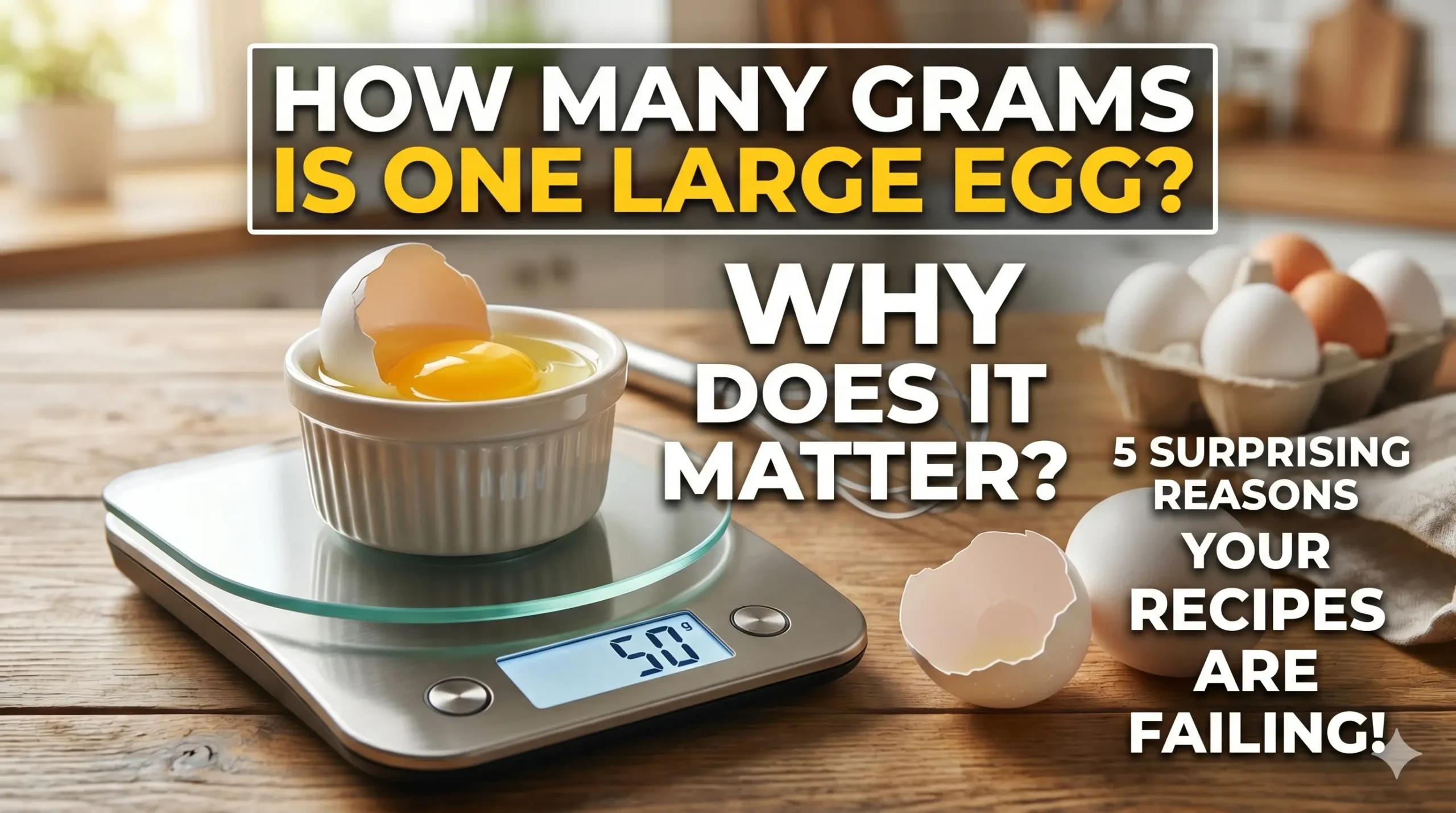
One large egg without the shell weighs about 50 grams. This is the standard weight most often used in cooking and baking when a recipe says “1 large egg.”

If you have ever wondered how many grams is one large egg without the shell, the simple answer is about 50 grams. This is the average edible weight of a standard large chicken egg and is the number most cooks and bakers use in recipes.
Egg size can vary slightly from one egg to another, so the exact weight is not always identical. Still, 50 grams is the most practical and widely accepted benchmark for a large egg without its shell.
Egg Weight Conversion Table
| Egg Size | Weight Without Shell | Weight With Shell |
|---|---|---|
| Small | about 40 g | about 47 g |
| Medium | about 44 g | about 51 g |
| Large | about 50 g | about 57 g |
| Extra Large | about 56 g | about 64 g |
| Jumbo | about 63 g | about 71 g |
This table helps when a recipe gives egg size in counts instead of grams. It also makes it easier to scale recipes up or down without guessing.
Why Egg Weight Matters
Eggs are not just simple ingredients. They add structure, moisture, richness, and stability to many recipes. Because of that, even a small difference in egg weight can affect the final result.
This matters most in baking. Cakes, cookies, muffins, custards, sponge cakes, and pastries often depend on precise ingredient balance. If you use a much larger or smaller egg than the recipe expects, the texture may change.
For everyday cooking, the difference is usually minor. For baking, using grams gives better consistency and more reliable results.
Large Egg Breakdown
A large egg without the shell usually contains:
- Egg white: about 30 grams.
- Egg yolk: about 18 to 20 grams.
- Total edible weight: about 50 grams.
The shell itself adds roughly 7 grams. That is why a whole large egg typically weighs around 57 grams before cracking.
When to Use Grams Instead of Egg Count
Using grams is best when accuracy matters. This is especially useful in:
- Cakes and cupcakes.
- Custards and puddings.
- Macarons.
- Bread and brioche.
- Pastry dough.
- Professional baking recipes.
If a recipe only says “1 large egg,” you can safely use one standard large egg. But if the recipe lists grams, always follow the weight for the best result.
Simple Egg Conversion Guide
Here is a quick way to estimate large egg quantities:
- 1 large egg = about 50 grams.
- 2 large eggs = about 100 grams.
- 3 large eggs = about 150 grams.
- 4 large eggs = about 200 grams.
This makes recipe scaling much easier. If a recipe needs a half portion, you can also beat the egg and weigh out the needed amount.
Common Questions About Egg Weight
Is one large egg always exactly 50 grams?
No. Fifty grams is the standard average, but real eggs can be a little lighter or heavier.
Does the shell count in recipe weight?
Usually no. When recipes mention egg weight for cooking or baking, they typically mean the edible part without the shell.
Can I use medium eggs instead of large eggs?
Yes, but the result may be slightly different. If precision matters, adjust by weight rather than by count.
Why do some recipes fail when the egg size is wrong?
Because eggs affect the balance of liquid, fat, and protein. Too much or too little egg can change texture, rise, and moisture.
How can I measure eggs more accurately?
Crack the egg into a bowl, beat it lightly, then weigh the amount needed in grams.
Conclusion
One large egg without the shell weighs about 50 grams, and that is the most useful standard for home cooks and bakers. Knowing this simple conversion helps you follow recipes more accurately and get better results every time.