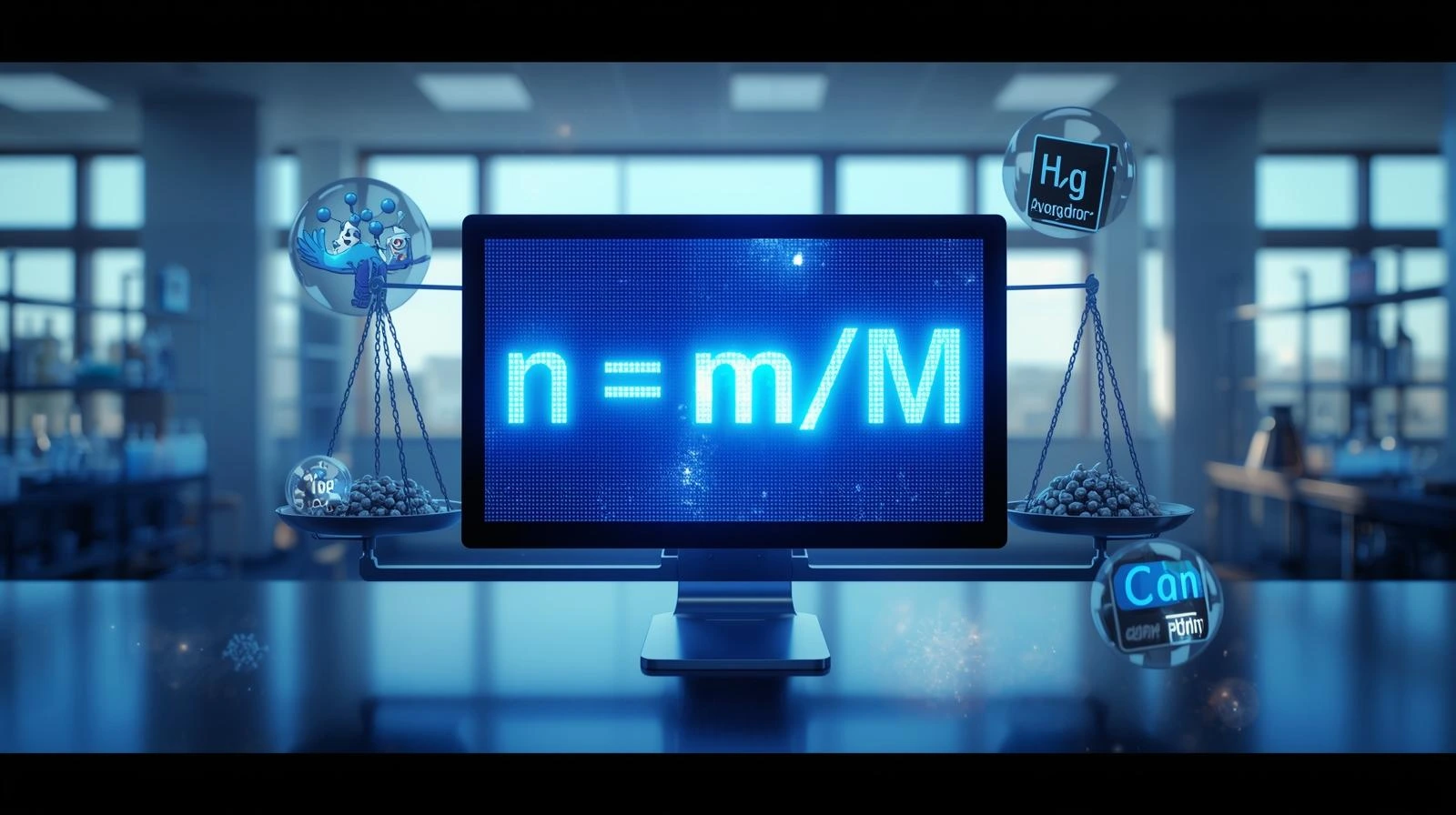
Converting grams to moles forms the foundation of chemistry calculations, especially in stoichiometry and lab experiments. This process uses molar mass to link measurable mass with the number of particles. The guide below breaks everything into clear steps, examples, and practical tips for easy understanding.
What is a Mole?
A mole serves as the basic unit for measuring the amount of substance in chemistry. It equals 6.022 × 10²³ particles, known as Avogadro’s number, whether those particles are atoms, molecules, or ions. This huge number allows chemists to work with practical masses instead of counting individual particles.
Molar mass represents the mass of one mole of a substance, measured in grams per mole (g/mol). For elements, it matches the atomic mass on the periodic table. Compounds combine the atomic masses of all atoms in their formula.
Grams to Moles Formula Explained
The formula is straightforward:
n=Mm
Here, n stands for moles, m for mass in grams, and M for molar mass in g/mol. Divide the given mass by the molar mass to get moles.
To go the other way, from moles to grams:
m=n×M
These equations ensure unit consistency—grams cancel with g/mol to leave moles.
Step-by-Step Conversion Guide
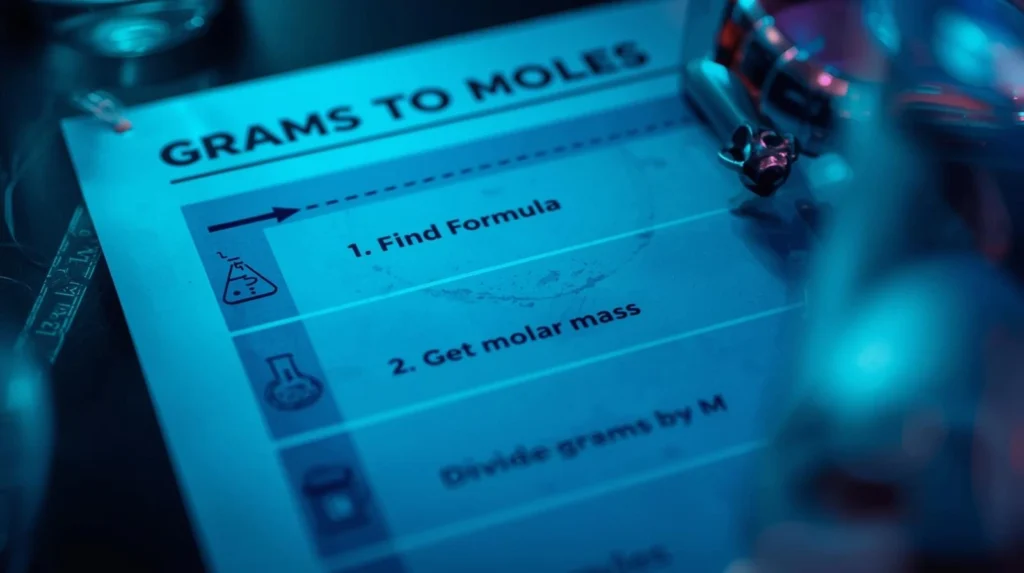
Follow these steps every time:
- Identify the substance: Write its chemical formula (e.g., H₂O for water).
- Calculate molar mass: Add atomic masses from the periodic table, multiplying by subscripts.
- Plug in values: Divide mass (grams) by molar mass.
- Check significant figures: Round to match the least precise input value.
- Verify units: Ensure grams and g/mol align.
Practice with paper first, then use a calculator for speed.
How to Calculate Molar Mass
Start with the periodic table for atomic masses.
- Elements: Use the listed value directly. Carbon (C) is 12.01 g/mol.
- Compounds: Multiply each atom’s mass by its count, then sum.
Water (H₂O): (2 × 1.01) + 16.00 = 18.02 g/mol.
Carbon dioxide (CO₂): 12.01 + (2 × 16.00) = 44.01 g/mol.
Sodium chloride (NaCl): 23.00 + 35.45 = 58.45 g/mol.
For complex molecules like glucose (C₆H₁₂O₆):
(6 × 12.01) + (12 × 1.01) + (6 × 16.00) = 180.16 g/mol.
Tip: Group atoms by type to avoid arithmetic errors.
Simple Examples: Grams to Moles
Example 1: Water
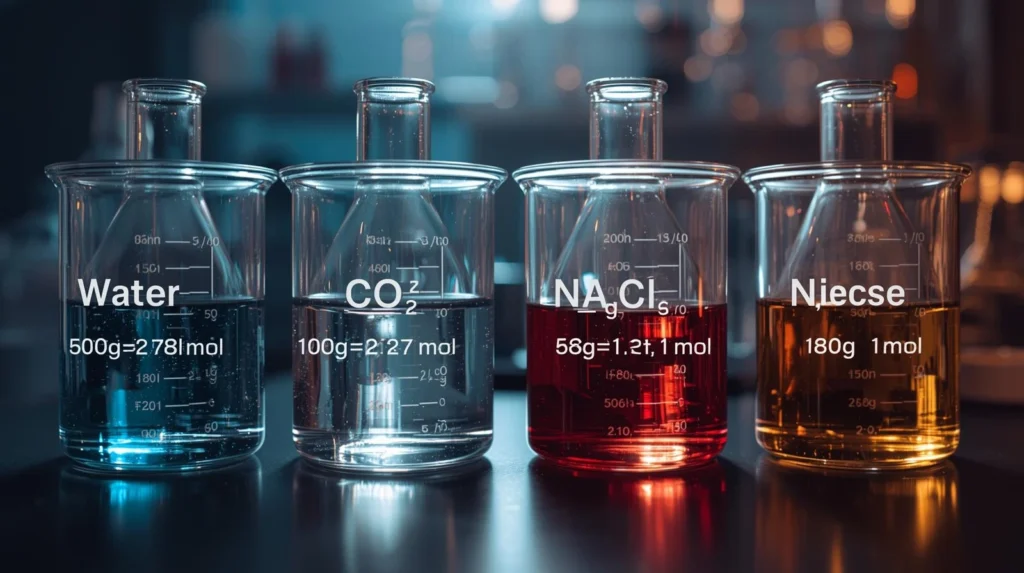
50 grams of H₂O. Molar mass = 18.02 g/mol.
Moles = 50 ÷ 18.02 ≈ 2.78 moles.
Example 2: CO₂
100 grams of CO₂. Molar mass = 44.01 g/mol.
Moles = 100 ÷ 44.01 ≈ 2.27 moles.
Example 3: NaCl
58.45 grams of NaCl. Molar mass = 58.45 g/mol.
Moles = 58.45 ÷ 58.45 = 1.00 mole exactly.
Example 4: Glucose
90 grams of C₆H₁₂O₆. Molar mass = 180.16 g/mol.
Moles = 90 ÷ 180.16 ≈ 0.50 moles.
These show everyday lab amounts.
Examples: Moles to Grams
Example 1: Oxygen gas
2 moles of O₂. Molar mass = 32.00 g/mol.
Grams = 2 × 32.00 = 64.00 grams.
Example 2: Water
3 moles of H₂O. Molar mass = 18.02 g/mol.
Grams = 3 × 18.02 = 54.06 grams.
Example 3: Sulfuric acid
0.5 moles of H₂SO₄. Molar mass = 98.09 g/mol.
Grams = 0.5 × 98.09 = 49.05 grams.
Reverse practice strengthens understanding.
Real-World Uses in Chemistry
In labs, recipes list grams, but reactions need moles for balancing. Stoichiometry converts grams of reactant A to grams of product B via mole ratios.
Pharmaceuticals calculate drug doses in moles for body absorption rates. Environmental tests measure pollutant grams but analyze in moles for reaction potential.
Manufacturing scales reactions: 1 mole of reactant yields X moles of product. Food science uses moles for nutrition from carb or protein grams.
Common Mistakes to Avoid
- Wrong molar mass: Don’t use atomic mass for compounds—sum all atoms.
- Unit errors: Confirm grams, not kilograms; g/mol, not kg/mol.
- Subscript forgetfulness: H₂O is 2 hydrogens, not 1.
- Rounding too early: Keep extra digits until the end.
- Calculator misuse: Double-check inputs.
Always write out steps to spot issues.
Quick Grams to Moles Calculator Method
Use an online tool:
- Enter chemical formula.
- Input grams.
- Click calculate for instant moles.
These auto-compute molar mass, ideal for checks or mobiles.
Stoichiometry with Grams to Moles
Balanced equation: 2H₂ + O₂ → 2H₂O.
From 4 grams H₂:
- Moles H₂ = 4 ÷ 2.02 ≈ 1.98 moles.
- Ratio: 2 moles H₂ make 2 moles H₂O.
- Moles H₂O = 1.98 moles.
- Grams H₂O = 1.98 × 18.02 ≈ 35.7 grams.
This “grams-moles-ratio-moles-grams” path solves most problems.
Advanced Tips for Precision
Use exact Avogadro’s number (6.02214076 × 10²³) only for particle counts. For hydrates like CuSO₄·5H₂O, include water mass.
In gases, moles relate to volume via ideal gas law: PV = nRT. Empirical formulas start with grams to moles for simplest ratios.
Frequently Asked Questions (FAQs)
What is the grams to moles formula?
n = m / M, where n is moles, m is grams, M is molar mass.
How do I find molar mass without a periodic table?
Memorize common ones or use an app; calculate by summing atomic masses.
Why convert grams to moles?
Moles let you use ratios in reactions, unlike mass alone.
What if the substance is an isotope?
Use the specific isotope mass, not average atomic mass.
Can I convert kilograms to moles?
Yes, convert kg to g first (multiply by 1000), then divide by M.
How many significant figures in answers?
Match the least precise value, often 3 for lab work.
What’s Avogadro’s number for?
It defines 1 mole as 6.022 × 10²³ entities.
Example for hydrate?
25 grams CuSO₄·5H₂O (molar mass 249.69 g/mol) = 25 ÷ 249.69 ≈ 0.10 moles.
Difference between molar mass and molecular mass?
Molar mass is in g/mol; molecular mass is atomic mass units (u), numerically equal.