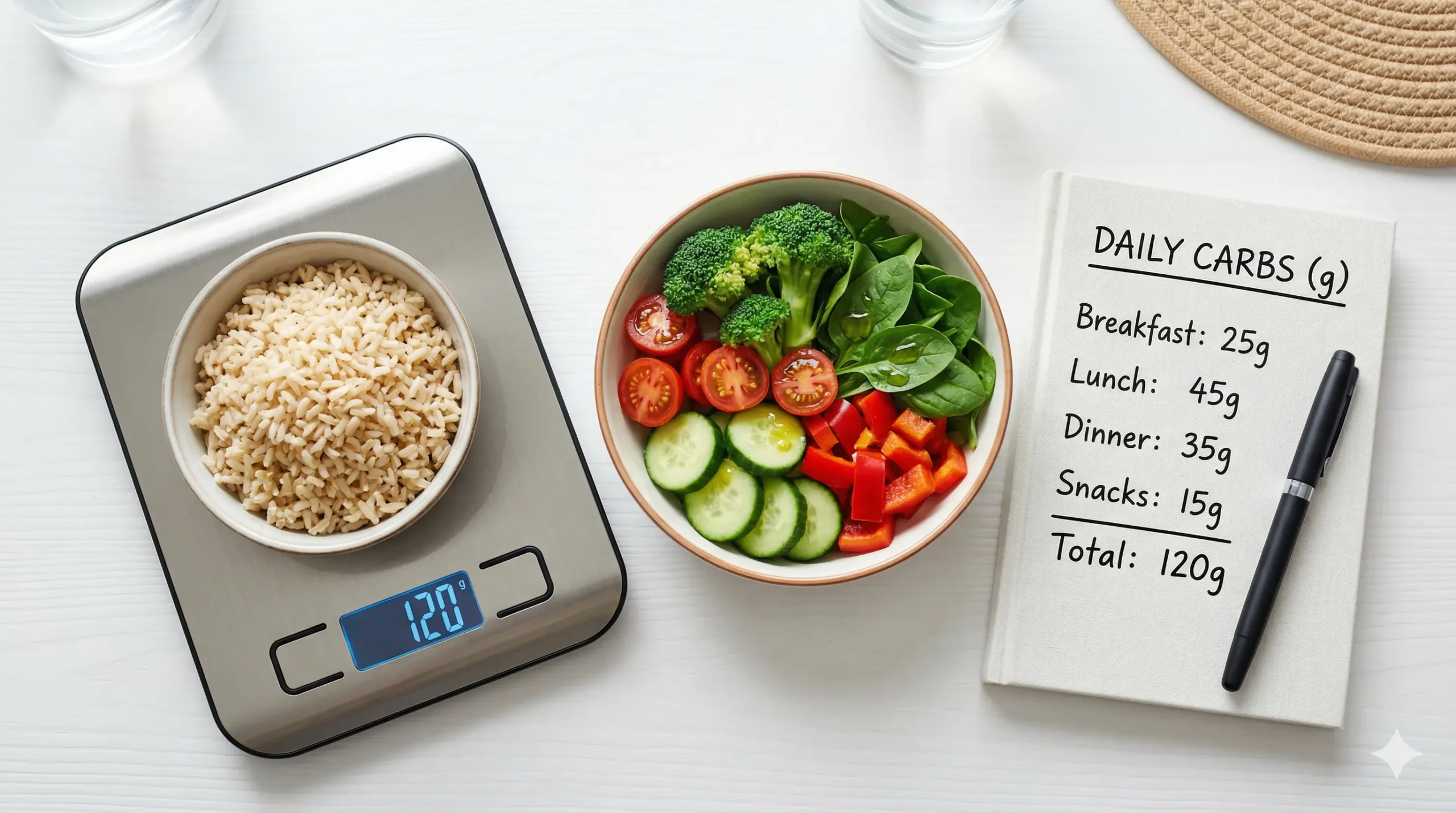
Carbohydrates are your body’s main fuel, but eating more carbs than you need makes losing weight much harder.
Once you know roughly how many grams of carbs per day suit your body, weight loss feels more controlled and less confusing.
In this guide, you’ll learn realistic carb ranges for weight loss, how to choose your own daily target, which carbs to focus on, and a simple example meal day you can adapt.
What Are Carbs and How Do They Affect Weight?
Carbohydrates are one of the three main macronutrients, along with protein and fat.
They are found in foods like grains, fruits, vegetables, legumes, dairy, and sugary snacks.
When you eat carbs, your body breaks them down into glucose, which raises blood sugar and provides energy.
If you consistently eat more carbs and calories than your body needs, the extra energy is stored, often as body fat.
On the other hand, cutting carbs too hard and too fast can cause tiredness, cravings, and difficulty sticking to your plan long term.
The goal is not zero carbs, but the right amount and the right types for your weight‑loss journey.
General Carb Recommendations (Big Picture)
Most healthy eating guidelines suggest that around 45%–65% of your daily calories can come from carbohydrates.
For someone eating 2,000 calories per day, that usually works out to roughly 225–325 grams of carbs daily.
This broad range is fine for general health or maintaining your weight.
But if your main goal is fat loss, many people benefit from gradually lowering their carb intake below the typical range, while still eating enough to feel energetic.
How Many Grams of Carbs Per Day to Lose Weight?
There is no single perfect carb number that works for everyone.
However, common ranges used in practice can help you find a good starting point.
1. Moderate carb reduction (ideal for most beginners)
- About 100–150 grams of carbs per day
- Works well for many people who want steady, realistic weight loss
- Easier to follow because it still allows fruit, some grains, and flexibility
This range often gives a good balance between energy, mood, and progress on the scale.
2. Low‑carb range
- Roughly 50–100 grams of carbs per day
- Typically leads to more noticeable carb reduction and can help control hunger and blood sugar
- Requires more planning but is still manageable for many people
Some low‑carb styles sit closer to 50 g, while others hover near 100 g, depending on your activity level and comfort.
3. Very low carb (keto‑style)
- Around 20–50 grams of carbs per day
- Often used to reach a state called ketosis, where the body burns more fat for fuel
- Can give faster short‑term results but is restrictive and not suitable for everyone
This level needs careful monitoring and is best approached with professional guidance, especially if you have any medical conditions.
Quick Carb‑Range Reference Table
| Goal / Eating Style | Approx. grams of carbs per day | Description |
|---|---|---|
| General healthy eating | 225–325 g | Typical intake at ~2,000 calories, good for maintenance |
| Moderate carb cut for weight loss | 100–150 g | Great starting point; more flexible and sustainable |
| Low‑carb weight‑loss approach | 50–100 g | Stronger focus on protein and healthy fats |
| Very low carb / keto‑style | 20–50 g | Highly restrictive; often used for short‑term or medical reasons |
Use this table as a guide, not a rigid rule.
You can move up or down in these ranges depending on how your body feels and how your weight changes over time.
How to Choose Your Ideal Daily Carb Target
Your best carb target depends on your body, your lifestyle, and your health.
Important factors include:
- Current weight and body‑fat level
- Daily activity (sitting most of the day vs. physically demanding work or training)
- Health conditions (such as diabetes, PCOS, thyroid or kidney issues)
- Your food culture, preferences, and what you can stick to long term
Step‑by‑step method to set your carb grams
- Estimate your calorie needs
Work out how many calories you need to maintain your weight, then subtract about 300–500 calories per day to create a sensible deficit, if that is safe for you. - Choose a carb percentage
- Moderate weight‑loss approach: 30%–40% of calories from carbs
- Low‑carb approach: 20%–30% of calories from carbs
- Very low carb: below 20% of calories from carbs
- Convert calories from carbs into grams
Carbs provide about 4 calories per gram.
Example: you eat 1,600 calories per day and choose 30% from carbs:- 1,600 × 0.30 = 480 calories from carbs
- 480 ÷ 4 = 120 g of carbs per day
- Test and adjust
Follow your chosen target for at least 2 weeks while tracking weight, energy, sleep, mood, and hunger.
If you feel exhausted, you might need more carbs. If weight is not changing at all, you may need to review both carbs and total calories.
Example Carb Targets by Lifestyle (Approximate)
These examples are general guidelines to illustrate how intake might vary.
- Mostly sedentary person, trying to lose weight:
- Around 80–130 g of carbs per day often works when total calories are controlled.
- Lightly to moderately active person (regular walks or light workouts):
- About 100–150 g of carbs per day can support energy and steady fat loss.
- Highly active person (intense training, manual labor, or sports):
- Carb needs may be much higher, sometimes several grams of carbs per kilogram of body weight, even when aiming to lose some fat.
Because everyone is different, working with a health professional or dietitian is the safest way to fine‑tune your personal numbers, especially if you take medications.
Best Types of Carbs for Weight Loss
Counting grams is helpful, but the quality of your carbs is just as important.
Two people can eat the same number of carb grams and get very different results depending on the foods they choose.
Better carb choices include:
- Non‑starchy vegetables: spinach, fenugreek leaves, cabbage, cauliflower, capsicum, gourds
- Whole fruits: berries, apples, pears, oranges, guava (in portions that fit your target)
- Whole grains: oats, brown rice, quinoa, millet, whole‑wheat roti or bread
- Legumes: lentils, chana, rajma (kidney beans), black beans
- Unsweetened dairy or alternatives: plain yogurt, milk, curd, unsweetened plant milks
Carbs to limit for easier fat loss:
- Sugary drinks: soft drinks, sweetened juices, energy drinks, sweet lassi
- Desserts and sweets: cakes, pastries, ice cream, chocolates, mithai
- Refined grain products: white bread, white pasta, many bakery items, most packaged snack foods
- Highly processed, ready‑to‑eat foods with lots of added sugar and refined flour
Focusing on high‑fiber, minimally processed carbs helps you stay full longer, control cravings, and maintain more stable energy.
Sample One‑Day Plan: Around 120 g of Carbs
This example shows how you might structure roughly 120 grams of carbs in a day.
Adjust food types and portion sizes to your culture and calorie needs.
Breakfast (about 30–35 g carbs)
- Rolled oats cooked with water or milk
- One small banana or a handful of berries
- One boiled egg or a serving of Greek yogurt for protein
Mid‑morning snack (about 10–15 g carbs)
- One small apple or orange
- A small handful of nuts (almonds, walnuts, peanuts) for healthy fats
Lunch (about 30–35 g carbs)
- Grilled chicken, fish, paneer, tofu, or dal as your main protein
- Large salad or mixed vegetables (cooked or raw)
- One small whole‑wheat roti or a small serving of brown rice
Evening snack (about 10–15 g carbs)
- Cucumber or carrot sticks with hummus or curd dip
- Or a small bowl of sprouts chaat
Dinner (about 30–35 g carbs)
- Lean protein: fish, chicken, tofu, paneer, or lentils
- Plenty of non‑starchy vegetables
- Small serving of quinoa, millet, or lentil‑based dish, or skip grains if your carb budget is already met
You can rearrange the carb amounts between meals as long as your daily total stays near your target.
Safety and Health Tips Before Cutting Carbs
Lowering carbs can be helpful, but it must be done safely.
Keep these points in mind:
- Talk to your doctor or dietitian if you have diabetes, high blood pressure, kidney disease, heart issues, are pregnant or breastfeeding, or take medicines that affect blood sugar.
- Avoid extreme carb restriction on your own if you have a history of disordered eating or very low body weight.
- Watch out for warning signs such as dizziness, headaches, strong cravings, irritability, or constipation—these may mean your plan is too extreme.
- Make sure your overall diet still contains enough protein, healthy fats, vegetables, and micronutrients, not just a low carb number.
Long‑term weight loss usually comes from a combination of a slight calorie deficit, good‑quality foods, movement, quality sleep, and stress management—not from slashing carbs alone.
Frequently Asked Questions (FAQs)
1. Can I lose weight on 50 grams of carbs per day?
Many people do lose weight on around 50 grams of carbs per day, especially if overall calories are also reduced. However, not everyone feels good on such a low number, so it is important to watch your energy, digestion, and mood.
2. Is 100–150 grams of carbs per day enough for weight loss?
For many adults, yes, 100–150 grams of carbs per day is enough to support weight loss when total calories are in a deficit. This range allows you to include fruits, some whole grains, and legumes without feeling extremely restricted.
3. What is considered a low‑carb diet in grams?
A common way to define low carb is anything under about 130 grams of carbs per day. Within that, some plans stay closer to 100–130 g, while others go down to 20–50 g.
4. Should I track net carbs or total carbs?
Net carbs are usually calculated as total carbs minus fiber and certain sugar alcohols. If you are new to tracking, it is often simpler to focus on total carbs and choose high‑fiber, minimally processed foods.
5. Are carbs at night bad for weight loss?
Eating carbs at night is not automatically bad. What matters more is your total calories and carb intake over the whole day, plus how well your dinner helps you avoid late‑night snacking.