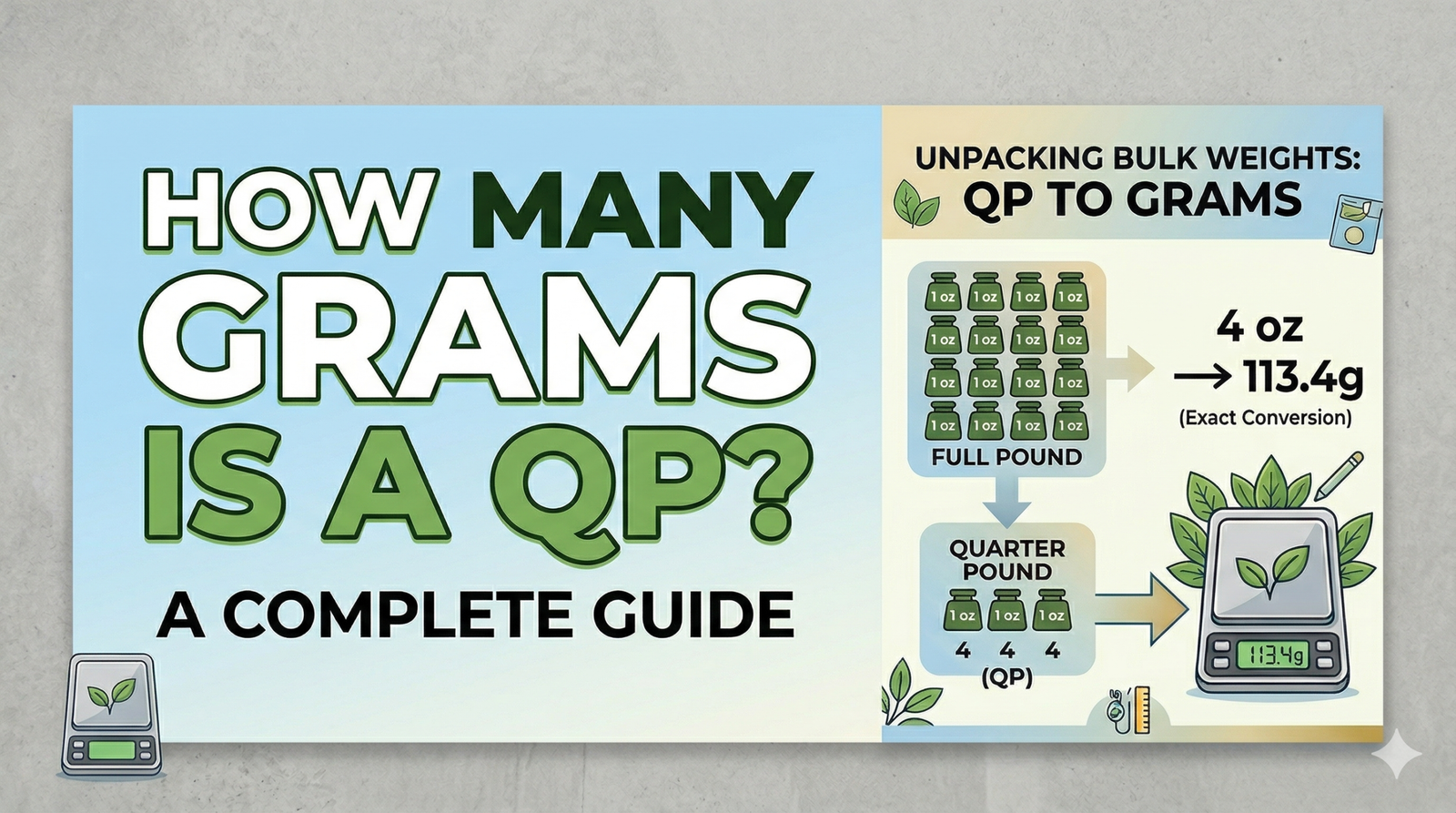
When navigating the world of bulk measurements—whether for culinary herbs, medicinal plants, or specialized spices—the term “QP” is a standard industry shorthand. But if you aren’t familiar with the lingo, you might find yourself asking: How many grams is a QP, and how does it fit into the larger weighing scale?
This guide breaks down the math, the conversions, and the practical context you need to understand this measurement like a professional.
What Exactly is a QP?
A QP stands for a Quarter Pound. In the United States customary system, weight is measured in ounces and pounds. To understand a QP, we first have to look at the standard pound ($lb$).
- 1 Pound = 16 Ounces
- 1/4 Pound (QP) = 4 Ounces
While ounces are great for domestic trade, the scientific and international community uses the metric system (grams). This is where the conversion becomes essential for accuracy.
How Many Grams are in a QP?
To get the exact number, we use the international avoirdupois pound standard, where one ounce is equal to approximately 28.3495 grams.
The Precise Math:

The “Street” or Commercial Standard:
In many commercial and casual industries, measurements are often rounded for simplicity. Most sellers and consumers round a single ounce to 28 grams.

Summary: A QP is technically 113.4 grams, though it is frequently referred to as 112 grams in casual trade.
QP Weight Comparison Table
To help you visualize where a QP sits in the hierarchy of weights, refer to this quick breakdown:
| Term | Ounces | Grams (Approx) |
| Eighth | 1/8 oz | 3.5g |
| Quarter | 1/4 oz | 7g |
| Half Ounce | 1/2 oz | 14g |
| Full Ounce | 1 oz | 28g |
| QP (Quarter Pound) | 4 oz | 113.4g |
| Half Pound | 8 oz | 226.8g |
| Full Pound | 16 oz | 453.6g |
Why Does Precision Matter?
Whether you are a chef portioning out expensive saffron or a collector of rare tea leaves, a discrepancy of 1.4 grams (the difference between the 112g and 113.4g total) can matter.
- Cost Efficiency: Over multiple transactions, losing a gram here and there adds up to significant financial loss.
- Legal Compliance: In regulated industries, scales must be calibrated to the decimal point to ensure they meet trade standards.
- Recipe Consistency: In botanical extractions, specific weight ratios are vital for the potency and quality of the final product.
Tips for Weighing a QP Accurately
If you are handling a quarter pound of material, a standard kitchen scale might not always provide the precision you need. Follow these steps:
- Use a Digital Scale: Ensure it has a capacity of at least 200g and a readability of 0.1g or 0.01g.
- The “Tare” Function: Always place your container on the scale first and press “Tare” or “Zero” so you are only weighing the product, not the bowl.
- Calibration: Use a calibration weight (usually 100g) periodically to ensure your scale hasn’t drifted.
Frequently Asked Questions (FAQs)
Is a QP the same as a “Quarter”?
No. In most contexts, a “Quarter” refers to a quarter of an ounce (7 grams). A “QP” refers to a quarter of a pound (113.4 grams).
How many “Eighths” are in a QP?
There are 32 eighths in a quarter pound (113.4 / 3.5 = 32.4).
Why do some people say a QP is 112 grams?
This is due to “rounding down” for convenience. Since an ounce is often simplified to 28g in casual settings, 28*4 equals 112g. However, if you are paying for a full quarter pound, you are technically owed that extra 1.4g!
How big is a QP physically?
This depends entirely on the density of the material. A QP of lead would be tiny, while a QP of dried basil might fill a large freezer bag.
Final Thoughts
Understanding the conversion of a QP to grams is essential for anyone dealing with bulk quantities. While the “rounded” 112g is common, knowing the true value of 113.4g ensures you are informed, professional, and getting exactly what you expect.