Grams to Moles Calculator
Step-by-Step Conversion Guide
Understanding the relationship between grams and moles is a foundation of chemistry. Whether you’re a student balancing chemical equations or a professional working in a laboratory, knowing how to convert grams to moles helps you measure chemical substances precisely and understand the composition of compounds.
What Is Grams to Moles Conversion?
In chemistry, grams measure the mass of a substance, while moles express the amount of that substance in terms of particles – atoms, molecules, or ions. One mole equals 6.022 × 10²³ particles, known as Avogadro’s number.
The conversion from grams to moles connects these two measurements using the molar mass, which represents the mass of one mole of a substance (in grams per mole or g/mol).
For example, water (H₂O) has a molar mass of approximately 18.02 g/mol, meaning 1 mole of water weighs 18.02 grams.
Grams to Moles Formula
The grams to moles conversion formula is straightforward:
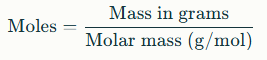
This formula divides the mass of your substance by its molar mass to determine how many moles you have.
Example:
If you have 36 grams of water (H₂O):
Moles = 36 ÷ 18.02 = 1.998 moles (≈ 2 moles)
Step-by-Step Conversion Process
Follow these simple steps to convert grams into moles accurately:
- Identify the chemical formula of the substance (e.g., H₂O, NaCl, CO₂).
- Find the molar mass by adding the atomic masses of all elements in the formula.
- Use the formula: Moles = Grams ÷ Molar Mass.
- Round the result to match the significant figures of your given data.
This process works for any compound, from simple elements to complex organic molecules.
Worked Examples
Let’s take a few examples to understand better:
Example 1: Carbon Dioxide (CO₂)
- Given mass = 44 g
- Molar mass of CO₂ = 12.01 + (16 × 2) = 44.01 g/mol
- Moles = 44 ÷ 44.01 = 1.00 mol
Example 2: Glucose (C₆H₁₂O₆)
- Given mass = 18 g
- Molar mass = 180.16 g/mol
- Moles = 18 ÷ 180.16 = 0.10 mol
Example 3: Sodium Chloride (NaCl)
- Given mass = 58.5 g
- Molar mass = 58.44 g/mol
- Moles = 58.5 ÷ 58.44 = 1.00 mol
These examples show how simple and consistent the conversion process is once you know the molar mass.
Common Mistakes to Avoid
Many learners slip up on small details. Keep these tips in mind:
- Don’t skip subscripts: They directly affect the molar mass. For instance, H₂O is not the same as HO.
- Convert units properly: Always convert milligrams or kilograms into grams before applying the formula.
- Use accurate atomic masses: Small rounding errors can lead to significant deviations in results.
- Mind significant figures: Round off final values based on the precision of given data.
Why Grams to Moles Conversion Matters
In chemistry, every reaction depends on precise ratios of reactants. Converting grams to moles ensures the correct stoichiometric relationships for accurate results. Industrial chemists, pharmacists, food scientists, and researchers all rely on mole-based calculations daily.
Even though calculators and online tools make the process faster, understanding the formula helps students and professionals build a stronger conceptual foundation in chemistry.
Frequently Asked Questions (FAQs)
1. What is molar mass and how do I find it?
Molar mass is the mass of one mole of a substance. You can find it by adding the atomic masses of all atoms in a molecule using the periodic table.
2. How do I convert moles back to grams?
Use the reverse formula: Grams = Moles × Molar Mass.
3. Why do chemists use moles instead of grams?
Moles allow chemists to count atoms and molecules without relying on impractical large numbers, ensuring balanced chemical equations.
4. Can I use a calculator for conversion?
Yes! You can use a grams-to-moles calculator to get instant results, but always understand how the formula works first.
5. What is Avogadro’s number?
It’s the number of atoms, ions, or molecules in one mole of a substance – approximately 6.022 × 10²³.