Grams to Tonnes (g to t)
Need to convert grams to metric tons quickly? This simple guide breaks down the conversion process, explains key concepts, and includes easy examples and a handy conversion table. Use the interactive calculator below to get instant results.
Grams to Tonnes Conversion
Grams to Metric Tons (Tonnes) Converter (g to t)
Instantly convert between grams and metric tons with this smart calculator.
Start typing to see the calculation.
Quick Reference
| 1,000 g | 0.001 t |
| 10,000 g | 0.01 t |
| 100,000 g | 0.1 t |
| 500,000 g | 0.5 t |
| 1,000,000 g | 1 t |
The Gram to Metric Ton Conversion Factor
1 metric ton (tonne) = 1,000,000 grams (g)
To convert grams to tonnes, divide the number of grams by 1,000,000 or multiply by 1 × 10⁻⁶ in scientific notation.
How to Convert Grams to Metric Tons (Step-by-Step)
Conversion Formula (g to t)
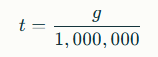
Where:
- t = mass in metric tons (tonnes)
- g = mass in grams
Conversion Factor: 1 g = 1 × 10⁻⁶ t
Example Calculation: Converting a Sample Weight to Tonnes
Suppose you have 250,000 grams of sand.
250,000÷1,000,000=0.25 tonnes
That means 250,000 g equals 0.25 tonnes or a quarter of a metric ton.
Reverse Conversion: Tonnes to Grams
To convert back, multiply by 1,000,000:
t×1,000,000=g
For example, 1.5 t × 1,000,000 = 1,500,000 g
What Is a Gram (g)? Definition and Context
A gram (g) is a unit of mass commonly used for smaller quantities in everyday life — from measuring ingredients to weighing jewelry or medicines. It belongs to the metric system, which is based on powers of ten for simple conversions.
The Gram in the International System of Units (SI)
In the SI system, the kilogram (kg) is the base unit of mass. The gram is defined as one-thousandth of a kilogram:
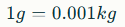
This decimal-based structure allows seamless scaling between milligrams (mg), grams (g), kilograms (kg), and metric tons (t).
Historical Origin: The Water Standard
Historically, one gram was defined as the mass of one cubic centimeter (cm³) of pure water at 4°C - the temperature of maximum water density. Although now defined by the Planck constant, the gram remains deeply connected to this water-based heritage in science and education.
What Is a Metric Ton (t) or Tonne? Definition and Purpose
A metric ton (tonne), symbolized as t, equals 1,000 kilograms or 1,000,000 grams. Widely used across international trade, industry, and shipping, the metric ton is part of the SI-derived units recognized under the European standard and most global measurement systems.
Key Relationships: Kilograms (kg) and Pounds (lb)
- 1 tonne = 1,000 kilograms
- 1 tonne ≈ 2,204.62 pounds (lbs)
These relationships make it easier to compare measurements between the metric system and US customary units.
Metric Ton vs. Imperial/US Tons: Avoiding Conversion Confusion
Although they sound similar, not all “tons” are equal — and this causes common conversion mistakes.
Metric Ton (Tonne): The International Standard (1,000 kg)
Used in most countries worldwide, especially in science, freight, and agriculture, the metric ton (t) or tonne equals 1,000 kilograms. It is the preferred unit in the SI and international trade.
US Ton (Short Ton): The American Standard (2,000 lbs)
The short ton (US ton) is part of the US customary system, equal to 2,000 pounds or roughly 907.185 kg. It’s primarily used in North America for measuring goods like coal, cement, or freight.
UK Ton (Long Ton): The Imperial Standard (2,240 lbs)
In the UK Imperial system, one long ton equals 2,240 pounds, or approximately 1,016.046 kg. Though less common today, it still appears in maritime and road haulage contexts.
Why Is It Sometimes Spelled "Tonne"?
The term “tonne” (with ‘-ne’) is the international spelling for the metric ton, widely used in Europe and most of the world. “Ton” (without ‘ne’) is more general and refers to either short or long imperial tons. Using “tonne” avoids confusion in global communication.
You also check our Grams to Tablespoons conversion.
When Is the Gram to Ton Conversion Needed?
Converting between grams and metric tons helps bridge small-scale precision with large-scale industrial measurement. Let’s explore the real-world contexts.
Gram Applications (Small Scale): Cooking, Nutrition, and Medicine
Grams are essential in culinary recipes, nutritional labeling, and pharmaceutical dosages. For example:
- 5 grams = one teaspoon of sugar.
- 500 g = one loaf of bread.
Precision in grams ensures accuracy in formulation and quality control.
Metric Ton Applications (Large Scale): Industry and Global Trade
The metric ton dominates shipping, construction materials, agriculture, and commodity trading. Examples include:
- Freight capacity and cargo payload calculation.
- Crop yields (e.g., wheat or rice measured in tonnes).
- Environmental accounting, such as CO₂ emissions per tonne.
In international trade, the tonne standardizes mass across borders.
Converting Materials: Understanding Density (Mass vs. Volume)
You can’t directly convert volume (e.g., cubic meters) to mass (e.g., tonnes) without knowing density. For materials like iron or oil:
Mass (t)=Volume (m³)×Density (t/m³)
This distinction between mass and volume is key in shipping, petroleum, and construction.
Practical Example: Shipping Container Weights
A 20-foot shipping container might carry 21-25 tonnes of goods depending on total cargo payload and freight limits. Understanding conversions helps logistics managers ensure compliance with road haulage and cargo regulations.
Gram to Metric Ton Conversion Table
| Grams (g) | Metric Tons (t) |
|---|---|
| 1,000 g | 0.001 t |
| 10,000 g | 0.01 t |
| 100,000 g | 0.1 t |
| 500,000 g | 0.5 t |
| 1,000,000 g | 1 t |
| 5,000,000 g | 5 t |
People Also Ask: Common Gram and Tonne Questions
1. How many grams are exactly in one metric ton?
There are exactly 1,000,000 grams in a metric ton because 1 tonne = 1,000 kilograms and 1 kilogram = 1,000 grams.
2. Is 1 metric ton heavier than 1 US ton (short ton)?
Yes. A metric ton equals 1,000 kg (2,204.6 lbs), while a short ton equals 2,000 lbs (907.185 kg). The metric ton is about 10% heavier.
3. What is the difference between a tonne and a metric ton?
They are identical — both represent 1,000 kilograms. The term tonne is standard in most countries; metric ton is often used in the US to avoid confusion.
4. What formula is used to convert grams to metric tons?
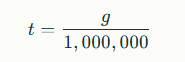
or equivalently g×1×10⁻⁶.
5. What real-world items weigh around 1 metric ton?
A small car, large horse, mid-size dairy cow, or 1 cubic meter of water all weigh roughly 1 tonne.
6. Can I convert cubic meters to metric tons directly?
No, you must know the density of the material. For example, concrete (~2.4 t/m³) is denser than water (1.0 t/m³).
7. Why is the gram used instead of the kilogram in daily life?
Grams make measurements more practical for smaller items (food, medicine). Using grams avoids too many decimals in everyday conversions.
8. What is the standard international usage for the metric ton?
The metric ton (tonne) is the global mass standard in shipping, agriculture, construction, and environmental science.