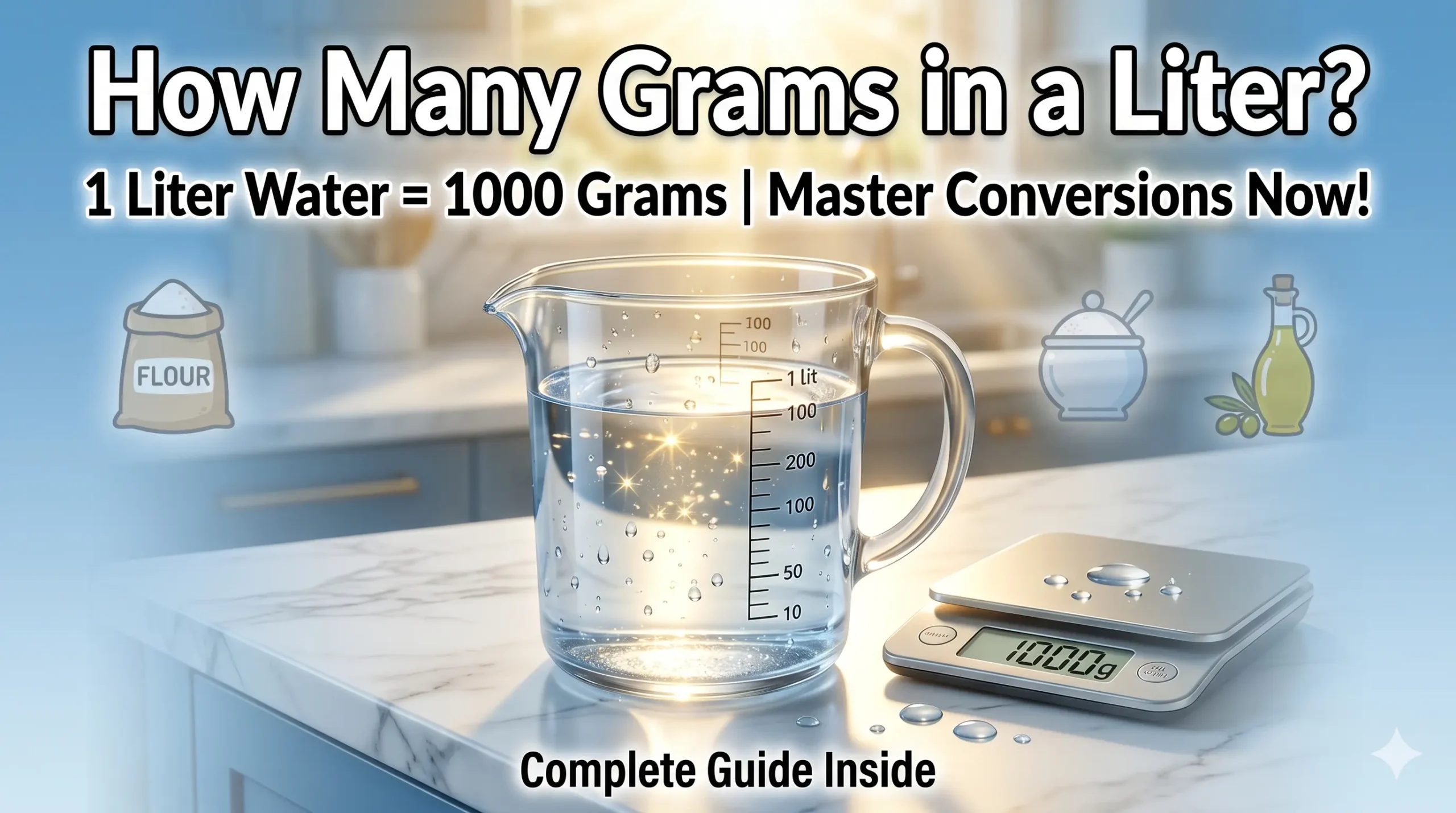
Grams measure mass, while liters measure volume, so direct conversion depends on density. For water at standard conditions, 1 liter equals exactly 1,000 grams. This guide breaks it down simply for cooking, science, or everyday use.

Understanding Grams and Liters
Grams (g) belong to the metric system’s mass units, where 1 gram equals about the weight of a paperclip. Liters (L), on the other hand, measure volume, like the space in a standard water bottle holding 1 liter. You can’t convert them directly without knowing the substance’s density, which tells how much mass fits in a given volume.
Density is key here—it’s mass per unit volume, often in grams per milliliter (g/mL). For pure water at 4°C, density is 1 g/mL, making conversions straightforward. Other substances vary, like oil being lighter or sugar denser when packed.
The Basic Conversion Formula
Use this formula to convert liters to grams: Grams = Liters × Density (g/mL) × 1,000. Since 1 liter = 1,000 mL, multiply accordingly. For grams to liters, it’s Liters = Grams ÷ (Density × 1,000).
This works because 1 mL of water weighs 1 gram, scaling up to 1,000 grams per liter. Always check the substance’s density at room temperature for precision, as temperature affects it slightly.
Grams in 1 Liter of Water
One liter of pure water weighs exactly 1,000 grams (or 1 kilogram). This standard holds at 4°C under normal pressure, a benchmark in science and cooking. In recipes, assume this unless specified otherwise.
Real-world tap water might vary by a gram or two due to minerals, but it’s negligible for most purposes. Think of it as filling a 1-liter bottle—it tips the scale at 1 kg.
Common Substance Conversions
Different items have unique densities, changing the grams per liter. Here’s a quick reference table for everyday use:
| Substance | Density (g/mL) | Grams in 1 Liter |
|---|---|---|
| Water | 1.00 | 1,000 |
| Milk | 1.03 | 1,030 |
| Olive Oil | 0.92 | 920 |
| All-Purpose Flour | 0.53 | 530 |
| Granulated Sugar | 0.85 | 850 |
| Honey | 1.42 | 1,420 |
These values are approximate; sifting flour reduces density, while packing sugar increases it. Measure accurately for best results.
Step-by-Step Conversion Examples
Water Example
To find grams in 2 liters of water: 2 × 1.00 × 1,000 = 2,000 grams. Simple and direct.
Flour Example
For 0.5 liters of flour (density 0.53 g/mL): 0.5 × 0.53 × 1,000 = 265 grams. Perfect for baking adjustments.
Oil Example
1 liter of olive oil: 1 × 0.92 × 1,000 = 920 grams. Lighter than water, so it floats—handy for recipes.
Practice these to build confidence; use a kitchen scale for verification.
Why Density Matters Most
Without density, conversions fail—grams are weight, liters are space. Liquids like water are easy, but powders shift with packing. Temperature tweaks density too; hot water expands slightly, weighing less per liter.
In cooking, this explains why volume measures vary: a cup of flour can weigh 120-150 grams depending on scooping. Always prioritize weight for precision.
Practical Tips for Cooking and Baking
Weigh ingredients over measuring volume for consistency, especially in baking. Use the formula for recipe scaling—double the liters, adjust grams by density. Store density charts handy for quick checks.
For liquids, a measuring jug works fine since densities are stable. Test small batches to dial in your method.
Grams vs. Liters in Science and Industry
Labs use this conversion for solutions, like 1 liter of saline at 0.9% being 9 grams of salt in 1,000 grams water. Industries scale it for chemicals or fuels. Precision tools like hydrometers measure density on-site.
Quick Reference Chart: Liters to Grams
| Liters | Water (g) | Flour (g) | Sugar (g) |
|---|---|---|---|
| 0.5 | 500 | 265 | 425 |
| 1 | 1,000 | 530 | 850 |
| 2 | 2,000 | 1,060 | 1,700 |
| 5 | 5,000 | 2,650 | 4,250 |
Bookmark this for daily use; it saves time in the kitchen or workshop.
FAQs
How many grams in a liter of water?
Exactly 1,000 grams at standard conditions.
Can I convert grams to liters without density?
No, density is essential since mass and volume differ.
How much does 1 liter of milk weigh in grams?
About 1,030 grams due to its slightly higher density.
What’s the grams to liters formula for flour?
Liters = Grams ÷ (0.53 × 1,000).
Does temperature affect grams per liter?
Yes, warmer liquids expand, reducing grams per liter slightly.